
Artificial intelligence is pushing data center infrastructure into a new era. Much of the industry conversation has focused on rising rack densities and the physical demands placed on cooling and power systems. But there is another change happening just as quickly – and with just as much impact.
AI is increasing control complexity.
Today’s mission-critical data centers are operating across more modes, tighter tolerances, and higher-consequence failure scenarios than ever before. At the same time, many facilities are being asked to do more with fewer on-site personnel. This combination of increased system complexity and reduced human oversight has fundamentally changed what reliability means.
Reliability Is No Longer About Equipment Alone
Modern data center reliability isn’t defined solely by the quality of mechanical equipment. It is defined by how systems are controlled, sequenced, and automated across all operating conditions.
As facilities grow more complex, they must seamlessly manage:
- Frequent load changes and rapid ramp-ups
- Redundant and failover operating modes
- Abnormal conditions and component failures
- Transitions between utility, backup, and emergency power
Without a carefully engineered controls strategy, even well-designed mechanical systems can struggle to perform as intended.
Controls Belong Early in the Design Conversation
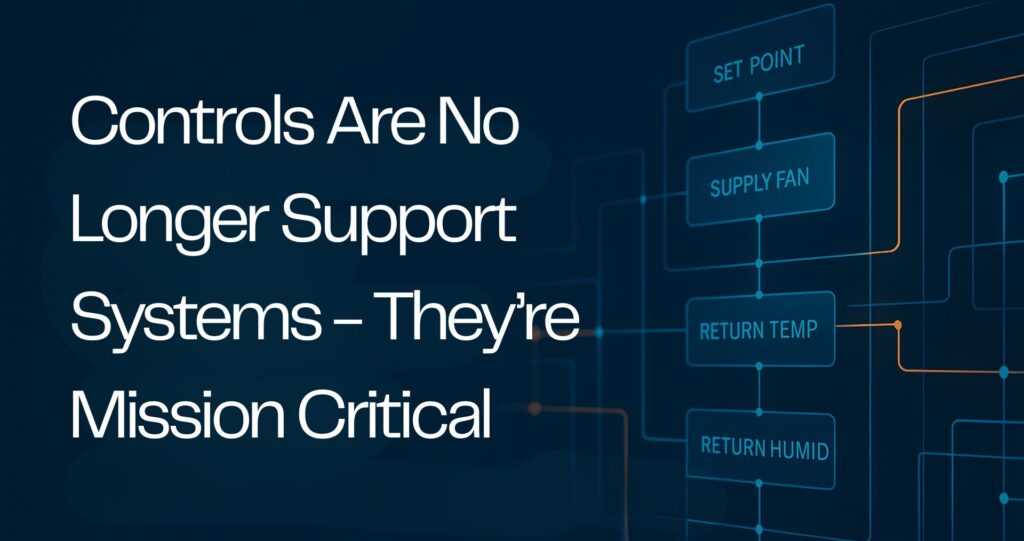 At PHS, we’re seeing a clear shift in how leading data center owners and designers approach controls. Rather than treating Building Management Systems (BMS) as a layer added late in the project, controls are moving earlier in the design process – where they belong.
When automation is embedded into mechanical design from day one, facilities benefit from:
- Higher availability through consistent, repeatable system operation
- Clean transitions between operating modes, reducing risk during changeovers
- Improved resilience during abnormal conditions, when reliable automation matters most
Early integration allows controls to support the full intent of the mechanical design, rather than trying to compensate for gaps after the fact.
Automation as Core Infrastructure
As data centers evolve, controls are no longer simply support systems. They are part of the backbone that enables uptime, scalability, and operational confidence.
Well-designed automation reduces dependence on manual intervention, supports lean staffing models, and ensures systems respond predictably under pressure. In an AI-driven environment, that reliability is no longer optional.
Let’s Talk About Your Controls Strategy
If your facility is facing BMS complexity, reliability concerns, or a need to optimize existing systems, the PHS team is always happy to help.
Reach out to PHS to learn how mission-critical controls can work for your operation – not against it.